New York rewards a plan. With just a weekend, the trick is to group the city into two big loops — downtown and Brooklyn on day one, Central Park to the High Line on day two — so you spend your 48 hours walking iconic streets instead of crisscrossing them underground. Some of the very best of NYC is free, and the splurges that remain are worth ranking carefully. Here's the exact plan, with prices for both.
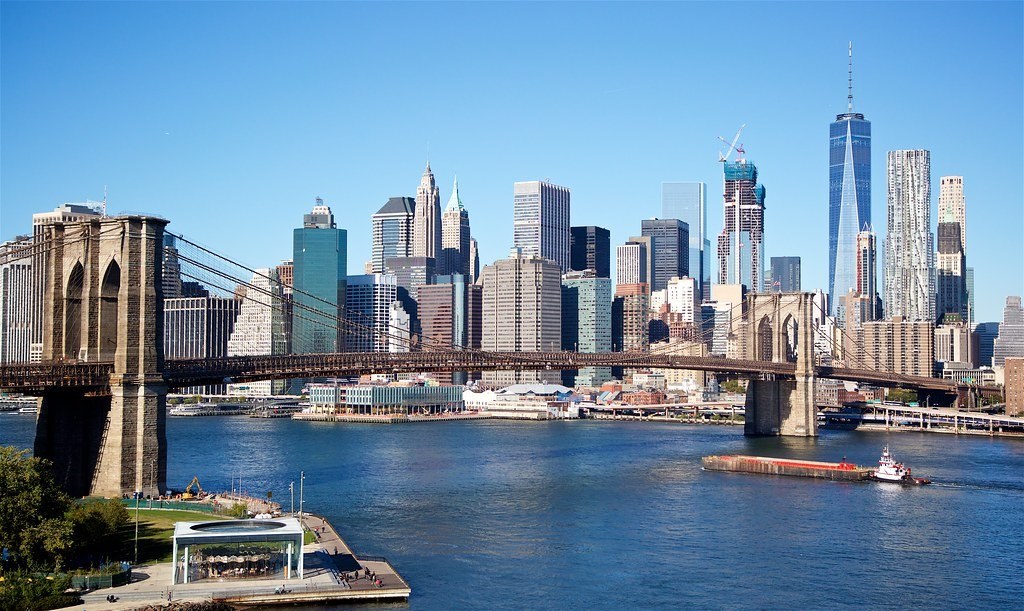
Day 1: Downtown — Brooklyn Bridge to Broadway
Morning: Brooklyn Bridge & DUMBO
Start on the Brooklyn side at 8am and walk the bridge toward Manhattan — free, and the skyline grows with every step. First, though, grab a proper bagel with schmear in Brooklyn Heights ($5–7) and get the famous Manhattan Bridge photo on Washington Street in DUMBO before the crowds stack up. If you have twenty spare minutes, Jane's Carousel spins inside its glass box right on the waterfront ($2 a ride), and the Brooklyn Heights Promenade offers the skyline with park benches attached.
Afternoon: Lower Manhattan
Ride the Staten Island Ferry — completely free, 25 minutes each way, and it sails right past the Statue of Liberty (stand on the right side heading out, left coming back). Back on land, pay your respects at the 9/11 Memorial pools (free; the museum is $33), look up inside Santiago Calatrava's winged white Oculus, and detour past the Charging Bull and Fearless Girl on Broadway. Lunch is a slice on cobblestoned Stone Street ($3–4), a block that still looks like 1837.
Evening: Broadway
Line up at the TKTS booth in Times Square from 3pm for same-day tickets at 30–50% off — most shows land at $70–110 instead of $180+. Even cheaper: enter the digital lotteries on show apps a day ahead, where hit musicals release seats for $30–50. After the curtain, Times Square at night is exactly as ridiculous and wonderful as advertised. Late-night dollar-ish pizza ($1.50–3) is the correct nightcap.
Day 2: Central Park, Museums & a Skyline Sunset
Morning: Central Park classics
Enter at 59th Street and wander north: The Mall's elm cathedral, Bethesda Terrace and its fountain, then Bow Bridge — the most photographed spot in the park. Pause at Strawberry Fields, the quiet Lennon memorial near the 72nd Street entrance, or rent a rowboat at the Loeb Boathouse ($25/hour, April–October). It's all free otherwise; a warm cookie from a nearby legendary bakery ($5–6) is not, but it's mandatory.
Afternoon: The Met, then the High Line
Give the Metropolitan Museum of Art ($30) two focused hours — the Temple of Dendur, the Impressionist wing, and the rooftop garden (open May–October) are the highlights reel; MoMA ($30) is the equally great modern-art alternative. Then subway down to Hudson Yards and walk the High Line south: 1.5 miles of elevated gardens threading through the buildings, free, ending at Chelsea Market for tacos or lobster rolls ($10–17). Detour onto Little Island, the tulip-shaped park floating on the Hudson — free, whimsical, and twenty minutes well spent.
Evening: sunset from the top
Pick your observation deck and book the sunset slot days ahead: Top of the Rock (about $43) has the classic Empire State Building view, while Edge (about $43) dangles you 100 stories over Hudson Yards on a glass-cornered sky deck. Either way, stay 45 minutes past sundown — the city lighting up is the show, and the crowds thin just as it gets good. Finish with dinner in the West Village, where tree-lined brownstone blocks hide the city's coziest restaurants: pasta or a proper burger runs $20–30, and the pretty streets are half the meal.
READ MORE: 2 Days in Paris: The Perfect Itinerary
What does a New York weekend cost?
- Budget: $140–200/day — a hostel or Long Island City hotel, bagels and slices, free ferries and parks, TKTS rush tickets.
- Mid-range: $250–400/day — a Midtown or downtown hotel, one Broadway show, one observation deck, sit-down dinners.
- Splurge: $600+/day — a Fifth Avenue view, orchestra seats, omakase, and a helicopter loop over the harbor.
Hotels are the budget-killer here — weekend rates drop in January–February and late summer, and our budget travel hacks can claw back a surprising amount. If you plan to stack multiple paid attractions, a CityPASS (about $146 for five) beats buying separately. Getting there is often the cheap part if you follow our cheap flights guide; NYC's three airports mean fares stay competitive year-round.
Here is what a realistic mid-range Saturday looks like on paper: a $6 bagel breakfast, $2.90 subway rides, a $15 lunch at Chelsea Market, a $43 sunset slot at Top of the Rock, an $85 TKTS ticket, and a $28 West Village dinner — roughly $180 before your hotel. Add a $170 Long Island City room and the day lands near $265. Swap the paid deck for the free Staten Island Ferry and the TKTS seat for a $40 lottery win, and the exact same day costs under $110.
Two smaller line items catch first-timers out. Tipping adds 18–20% to every sit-down meal, so read menus at their price plus a fifth. And coffee, snacks, and bottled water run $3–6 apiece in Manhattan; refilling a bottle at park fountains and grabbing $1.50 cart coffee instead of the $6 cafe pour quietly saves $15 a day without feeling like sacrifice.
Where to stay for a New York weekend
Pick your neighborhood by subway line, not by star rating. Long Island City, one stop from Grand Central on the 7 train, is the budget sweet spot: modern hotels run $140–190 on weekends, and Gantry Plaza State Park hands you a skyline view the Midtown hotels charge double for. The Financial District is the sleeper pick — its business hotels empty out on Saturdays, so $160–220 gets a room steps from the Brooklyn Bridge and the Staten Island Ferry, exactly where day one of this plan begins.
- Solo and social: HI New York on the Upper West Side has dorm beds for $60–80 a night, one block from Central Park.
- Midtown convenience: expect $250–350 — you're paying for a five-minute walk to Broadway, not for charm.
- Skip: the $99 "deals" across the river in New Jersey. The PATH train works fine, but you'll burn 40 minutes and $6 round trip every single time you want to be where you actually came to be.
Common mistakes first-timers make
- Taking a taxi from JFK at rush hour. The flat $70 fare becomes a 90-minute crawl on the Van Wyck. The AirTrain-plus-subway combo is $11.40 and immune to traffic.
- Eating within sight of Times Square. The same pasta costs $34 on 44th Street and $19 in Hell's Kitchen, three blocks west on Ninth Avenue.
- Riding the subway for short hops. Anything under 15 blocks is usually faster on foot once you count station stairs and waiting — and the street is the attraction.
- Buying observation deck tickets at the door. Sunset slots sell out days ahead, and walk-up pricing runs $10–15 higher than online.
- Scheduling every hour. The best New York moments — a stoop-side jazz trio, a street fair on Sixth Avenue — happen in the gaps you didn't plan.
One more that deserves its own paragraph: weekend subway service changes. The MTA does track work on Saturdays and Sundays, which means the train you researched may be rerouted or replaced by a shuttle bus. Check the MTA app or the paper signs taped up in the station before you descend, and build a 20-minute buffer around anything with a fixed start time — an 8pm Broadway curtain will not wait while your rerouted F train idles on the bridge.
Also resist the airport-transfer upsell chain. Shared shuttle vans sold inside the JFK terminal charge $25–30 per person and often take longer than the subway because they loop through six hotel drop-offs before yours. For the trip home, prebook a flat-rate car for about $75 rather than gambling on surge pricing, which can push a Sunday-evening rideshare to the airport past $90.
Rainy-day backup plan
Weather will not ruin this itinerary if you shuffle the order. Grand Central Terminal's whispering gallery and celestial ceiling cost nothing and sit on top of a food hall where lunch runs $12–18. The Morgan Library ($25) is a Gilded Age private library that feels like a movie set, and the American Museum of Natural History ($29) can swallow an entire wet afternoon under its blue whale. Chelsea Market covers both lunch and browsing in one dry block, and the Oculus doubles as covered passage between downtown sights. Even the Staten Island Ferry works in rain — the enclosed lower decks keep the harbor views and the price stays free. For more zero-cost ideas that work in any weather, our guide to free things to do in every city was practically written for New York.
If the rain settles in for the whole day, build a museum crawl around one neighborhood instead of dashing across town. On Museum Mile, the Met, the Guggenheim ($30), and the Cooper Hewitt ($22) sit within ten blocks of each other along Fifth Avenue, so you are never outside for more than five minutes. Downtown, pair the free 9/11 Memorial with the Oculus and a long ramen lunch ($16–18) in Tribeca. Broadway matinees are the classic wet-Saturday move — TKTS opens at 11am for 2pm curtains, and rainy days often mean better seat availability.
Budget-wise, a wet day often comes out cheaper than a sunny one: one $25–30 museum, a $15 food-hall lunch, and a matinee rush ticket total less than a typical outdoor day of observation decks and impulse stops. Keep a $5 street-vendor umbrella in your bag rather than paying the $15 hotel-lobby markup the moment it starts pouring.
Frequently asked questions
Is the subway safe at night?
Broadly yes, on the routes this itinerary uses. Millions ride daily, and the busy Manhattan and brownstone-Brooklyn lines stay well-populated until midnight. Follow the local playbook: ride the center cars, stay off an empty platform end, and keep your phone gripped near the doors. After 1am, a $15–25 rideshare back to the hotel is money well spent.
How much should I tip?
Restaurants expect 18–20% on the pre-tax total; $1–2 per drink at bars is standard. Counter service is genuinely optional. Taxis and rideshares run 10–15%, and hotel housekeeping appreciates $2–5 a night. Budget it in — a $60 dinner is really a $75 dinner here.
Can I do this weekend without booking anything ahead?
Mostly. The bridge, ferry, parks, and High Line need zero planning. The two things to lock in early are your observation deck sunset slot and any specific Broadway show you'd be heartbroken to miss — everything else, including TKTS and museum entry, handles itself on the day.
What's the cheapest way to see the skyline?
Free, three ways: the Brooklyn Heights Promenade at dusk, the Staten Island Ferry at golden hour, and a $2.90 subway ride over the Manhattan Bridge on the B or D train — grab a north-facing window and watch the East River bridges line up.